Helianthus angustifolius
The name does the plant no favors. "Swamp sunflower" conjures boggy ground and standing water, which is where you find it in the wild, yes, but which is not where you need to plant it in the garden. Helianthus angustifolius tolerates wet soils in nature because wet soils are where it manages to grow without being outcompeted. In the garden, given good sun and average moisture, it performs considerably better and does not require a drainage problem to justify its presence. The name is a provenance note, not a planting instruction.
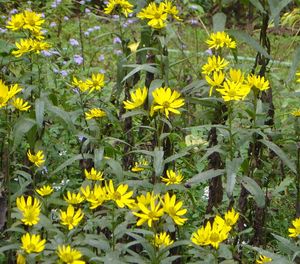
What the plant actually is: one of the best late-season natives available to Southern and mid-Atlantic gardeners, blooming from October through November at the precise moment when the rest of the border has exhausted itself. The flowers are classic sunflower in form, 2 to 3 inches across, with clear yellow rays surrounding a deep purplish-brown disc — the color combination that looks as if it was designed for October specifically, which in a biological sense it was. On a mature plant in full flower, the display is not subtle. Stems can reach 6 to 8 feet and branch freely in the upper third, so a well-sited colony becomes a mass of yellow that carries from across the garden.
The ecological credentials are worth knowing. The bloom period overlaps directly with the Monarch migration, and the nectar is relied upon by southbound butterflies refueling along the Eastern Flyway. The plant is also a larval host for several checkerspot and painted lady butterfly species. The seeds that follow are small but oil-rich, and songbirds, quail, and mourning doves work through the spent flower heads through winter. Leaving the stems standing until late winter costs nothing and returns something measurable to the local food web.
Helianthus angustifolius spreads by rhizome to form colonies over time, which is either useful or something to manage depending on what you want from it. Either way, a colony in October is worth the conversation.
The name does the plant no favors. "Swamp sunflower" conjures boggy ground and standing water, which is where you find it in the wild, yes, but which is not where you need to plant it in the garden. Helianthus angustifolius tolerates wet soils in nature because wet soils are where it manages to grow without being outcompeted. In the garden, given good sun and average moisture, it performs considerably better and does not require a drainage problem to justify its presence. The name is a provenance note, not a planting instruction.
What the plant actually is: one of the best late-season natives available to Southern and mid-Atlantic gardeners, blooming from October through November at the precise moment when the rest of the border has exhausted itself. The flowers are classic sunflower in form, 2 to 3 inches across, with clear yellow rays surrounding a deep purplish-brown disc — the color combination that looks as if it was designed for October specifically, which in a biological sense it was. On a mature plant in full flower, the display is not subtle. Stems can reach 6 to 8 feet and branch freely in the upper third, so a well-sited colony becomes a mass of yellow that carries from across the garden.
The ecological credentials are worth knowing. The bloom period overlaps directly with the Monarch migration, and the nectar is relied upon by southbound butterflies refueling along the Eastern Flyway. The plant is also a larval host for several checkerspot and painted lady butterfly species. The seeds that follow are small but oil-rich, and songbirds, quail, and mourning doves work through the spent flower heads through winter. Leaving the stems standing until late winter costs nothing and returns something measurable to the local food web.
Helianthus angustifolius spreads by rhizome to form colonies over time, which is either useful or something to manage depending on what you want from it. Either way, a colony in October is worth the conversation.
Original: $12.80
-70%$12.80
$3.84Description
The name does the plant no favors. "Swamp sunflower" conjures boggy ground and standing water, which is where you find it in the wild, yes, but which is not where you need to plant it in the garden. Helianthus angustifolius tolerates wet soils in nature because wet soils are where it manages to grow without being outcompeted. In the garden, given good sun and average moisture, it performs considerably better and does not require a drainage problem to justify its presence. The name is a provenance note, not a planting instruction.
What the plant actually is: one of the best late-season natives available to Southern and mid-Atlantic gardeners, blooming from October through November at the precise moment when the rest of the border has exhausted itself. The flowers are classic sunflower in form, 2 to 3 inches across, with clear yellow rays surrounding a deep purplish-brown disc — the color combination that looks as if it was designed for October specifically, which in a biological sense it was. On a mature plant in full flower, the display is not subtle. Stems can reach 6 to 8 feet and branch freely in the upper third, so a well-sited colony becomes a mass of yellow that carries from across the garden.
The ecological credentials are worth knowing. The bloom period overlaps directly with the Monarch migration, and the nectar is relied upon by southbound butterflies refueling along the Eastern Flyway. The plant is also a larval host for several checkerspot and painted lady butterfly species. The seeds that follow are small but oil-rich, and songbirds, quail, and mourning doves work through the spent flower heads through winter. Leaving the stems standing until late winter costs nothing and returns something measurable to the local food web.
Helianthus angustifolius spreads by rhizome to form colonies over time, which is either useful or something to manage depending on what you want from it. Either way, a colony in October is worth the conversation.